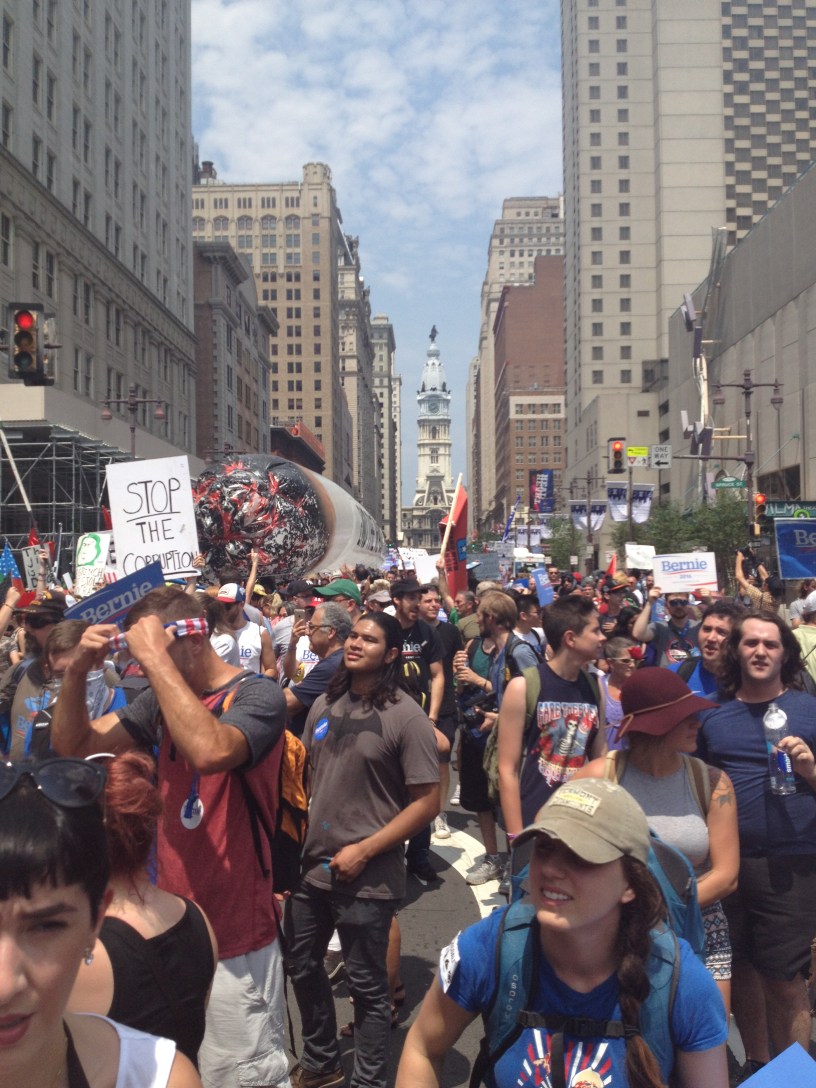
In light of the DNC and protests here in Philadelphia, I wanted to discuss my first day participating in the protest and my thoughts about the practices I observed. I saw both great and concerning things from Monday’s protests and wanted to remind those who may be interested in protesting- whether for political or environmental ends- that there are more effective strategies and etiquettes than others.
What is the main objective of a protest? The idea is to make a change: to change a mind, to change a law, to change an attitude, to change an injustice. But people are often very defensive of their opposing opinions, or ignorant of circumstances and issues, and protesters and their actions can be perceived in many different ways by observers. Therefore protests need to be considered sensitively in order to achieve effective results.
The most effective way of increasing the volume of support of a movement is to inform those who don’t know what’s going on: focusing energy not on those who already have taken a side in the matter, but those who have more potential to be as outraged as yourself, and thus more likely to join the cause. Ignorance hinders much participation and progress in politics and environmental issues.
Much media portrayal suggests protests consist of many enraged people screaming and shouting at calm officials and officers, painting the protestors to look like emotional, brutish nuisances. Unfortunately, if you take a step back from any protest you might witness or participate in, this image is realized more often than I’d like to admit. The raw energy and outrage of some protesters channels itself into unpolished and unorganized behavior.
In most cases, this is not an effective strategy. Nobody wants to learn or be inspired by someone disrespecting passersby or acting on unrefined outrage. The best way to sway a person to your side is to show respect and kindness, to listen to their side, and to have constructive, well-informed conversation. It comes back to the golden rule we all learned as kids: treat others the way you want to be treated. Though this strategy may not have the quickest results, someone will be much more inclined to consider your respectful, informative conversation or other protest methods, and allow themselves to be influenced by it in the long term than if they had been disrespected on the lines.
I am not saying that so much anger and outrage is out of line. I commend those with enough empathy to become ignited on behalf of an issue. I appreciate those not afraid to shout in the streets, to draw attention to themselves for what they believe to be the greater good. But organization in a protest is important. It sounds a lot better when people are chanting in unison and united behind a single cause than muddling the air with cries representing ten related causes.
In a march from city hall to the DNC yesterday, about 20 people stopped to form a brigade at a Mississippi state flag being flown on Broad Street as part of a display of the states put up by the city of Philadelphia. For those who don’t know, the Mississippi flag features an inset confederate flag.
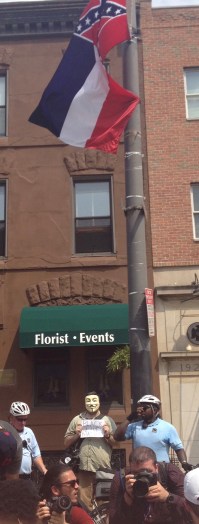
Black Lives Matter had strong representation in the crowd, and we wanted the oppressive symbol removed from “The City of Brotherly Love”. And so we sat on the street, demanding the flag be taken down, singing songs and chants and picking up hundreds of more supporters from the marches that passed by later in the day (The media coverage I’ve seen of this event vastly under-reports the amount of participants, at 50 people). Seems like a great strategy for a great cause, right? But it is easy for focus to be lost and efforts to be hindered, as I observed before we eventually accomplished the city taking down both Mississippi state flags that were flying. Luckily we were able to remain on track, but I’ll relay the rocks under our wheels.
One man in the original twenty people seemed exceptionally excited about taking part in the protest, attempting to take a leadership role among the people sitting there. Two pizzas materialized in his hands from the pizza shop we sat in front of. The twenty of us cheered as we saw food was in our immediate future and that we were getting support. But those cheers quickly turned to obscenities and a rip in unity among the small group.
The man opened the first pizza box and revealed a tasty looking white pie with dollops of spinach and ricotta. He started shouting to us:
“You see this here? This is a Philadelphia pizza! A WHITE pizza! You know what we think of that?” And he spiked the pizza to the ground. All of us posted in the street were infuriated:
“F*** you!”
“A**hole!”
“This isn’t about you!”
He wasn’t expecting the reaction he got, but he divided the group suddenly and violently. The cops watched on from all sides as we appeared to implode. He tried to talk his way out of the anger he received, but he only made people angrier. He tried to pass the other pizza out to alleviate the hungry protestors anger, but there wasn’t enough for everyone without the second pie, and some refused anyway on principle when he claimed he had bought the pizzas himself. The bickering and shouting among us continued for a little while, and the underlying anger lasted even longer.
This man made several mistakes, the most important of which being disrespecting his own team. He wasted food in front of hungry people and was trying to derive relevant meaning out of an irrelevant demonstration. If you get too ridiculous or bombastic, onlookers are less likely to give you any sort of credibility and your fellow protestors will be less willing to follow any leadership on your behalf.
Here is a video I took of the protest, when another march passed by us and joined the protest. You can see the police line dispersing to let the new protesters in.
After several hours the cherry picker showed up and first removed the far flag. As the crowd cheered, the police officers on bikes set up a line of the bicycles to keep the protestors safe from the truck as it made its way into the crowd.
The second flag was taken down and the crowd cheered more fervently as they began to disperse toward the convention. Some people lingered longer than others, waiting for those behind them to free up space. I was right up against the bicycle line and so waited for my turn to leave. The man next to me started shouting aggressively, only a foot away from several police officers, even though the crowd’s energy was completely being redirected:
“F*** the police! F*** the police! F*** the police!”
The police and Black Lives Matter are conflicting groups, I understand, and there’s a lot of institutional and individual racism within law enforcement in the U.S. that absolutely must be addressed. However, I don’t think this was an appropriate time or place for this response, when they were respectful of us the entire time. I found it foolish to risk the integrity of our main collective missions in Philadelphia for a high-risk tributary. We must pick and choose our battles strategically if we are to maximize progress made in any given protest or demonstration. Unprovokedly antagonizing police officers is a good way to demote the reputation of the movement. Many news sources would jump at the opportunity for a headline featuring rogue, violent protesters- even just a conveniently snapped photograph that could convince someone of that.
People were shaming black officers who were posted around the flagpole to protect it (and us) from rogue attempts to bring the flag down, screaming at them and calling them racist. But we must remember to not make the same mistakes that people with opposing views often make about any of us; a random individual should not be treated as a stereotype.
Remember they are humans too and this is stressful job and if you’re not specifically protesting the police, keeping the peace with them and maintaining respect will be your best course of action. Consider it an investment for the police’s prioritization of keeping protesters safe in future interactions they may have. Yes, they should be required to prioritize protester safety anyway, but as we all know well, this is not a perfect world.
It is important to stay focused when protesting. There are a lot of distractions and a lot of raw energy around, so it feels easy to get swept up into another issue or event and forget the original task at hand. The various ambitions and rationale of individuals within protests also widens the gap for possible departures from concentration. Especially at the DNC, where people from all over the country have come to express their concerns and frustrations about dozens of topics.
After the success on Broad and Passyunk, we all continued the long-delayed march south to the Wells Fargo Center. I was disappointed to see that the space apportioned to us protestors was far away and mostly out of sight of where the DNC would occur, and so many smaller groups of protesters gathered at various points along the fence that kept us out. I found one group in a corner of the fence that had great access to shout to DNC members and delegates who were crossing to the DNC out of the subway station. We shouted in tandem our last minute pleas for consideration, like: “Hell no, DNC, we won’t vote for Hillary,” or “A vote for Hillary is a vote for Trump”, and “Bernie beats Trump”.
I found these particular chants to be the most productive, as they considered Hillary delegates’ positions and likely thoughts more than our individual beliefs which often lie farther on the spectrum from these delegates’. We attempted to build a bridge out of the most common ground we shared with these delegates. Bernie has been dismissed by the DNC fully at this point, and so focusing on him individually in our protests may not be our best course of action; the best way to achieve what we are seeking is to appeal to their fear of a Trump presidency, based on dozens of consistent polls for hypothetical general elections.
I know I focused on my perceived negatives from Monday’s demonstrations, but I saw more good than bad. There was so much passion and determination in the crowds. Empathy and ambition emanated from the people. Tons of information was being spread around to anyone willing to hear. Many musicians helped keep morale and energy and collectivism in tact with meaningful, simple songs for everyone to sing along to. It’s much easier to listen to a good song than a long speech in that hot sun or pouring rain.
There were more people handing out water to strangers than we even needed. Some walked around with garbage and recycling bags, to show our respect for Philadelphia and the earth. Many individuals and groups were taking it upon themselves to document the protests to help spread the movement to those who weren’t able to make it to Philadelphia. I saw plenty of low-budget recording setups. We mostly treated each other as family, and collaborated for effective chants and songs and demonstrations.
At the same time, there are trolls out in the front lines that we must be careful of. Some people are very against what we stand for and will go to great lengths to rile up a crowd and send it in the wrong direction. We’ve had unaffiliated people try to bring out violence among the crowds, spreading rumors such as Bernie getting assaulted to try to enrage the people. They take advantage of the emotion and passion of the protesters to try to work against them. Take any outrageous news with a grain of salt- demand proof and react reasonably.
There were many people seeking many different sorts of justice there. I marched with communists, greens, workers party, democrats, socialists, and independents. We didn’t all agree with every one of each other’s views but we keep in mind that we have some common goals that need each other’s cooperation and passion to accomplish. Yes, it’s good to be mad, and feel passionate about injustice. But the trick to protesting well is to channel that anger and energy efficiently and effectively, which is not the easiest to do. We must remember that change is not easy and often requires sacrifice and cleverness on our parts. Force and disrespect is no way to build a revolution’s foundation.
Later this week I will be posting about running into Jill Stein in the Tuesday crowds, and report on the appalling things I heard Wednesday from Bernie delegates about the silencing happening within the convention. The media will not and has not reported these undemocratic practices these officials described, and so I will use this blog as a way to put that information out there.
 Garbage Girl: Environment & Politics