
Years ago I had been dismissive of organic food, chalking up the hype to some new-wave health trend to generate business. But the more I learned over time about nutrition, the human body, pesticides and the implications of other current agricultural practices, the more keen I grew on organic foods and keeping a close eye on the sources of my groceries. This post’s main focus is not about the costs and benefits of organic food to humans and the environment, but I will relay the basic accepted concepts briefly for context:
Non-organic food is often referred to as “conventional” food, which is quite a misleading term, given that these food items are products of the relatively new agricultural economy. Conventionally produced food products are subjected to pesticides and herbicides, biosolids, hormones, and antibiotics.
Biosolids are treated sewage that is used by the EPA as fertilizer in the United States. Whereas composting and reusing our waste are great for the environment and agriculture when applied properly, there are many concerns about the treatment processes of this sewage not being able to adequately diminish heavy metals, pathogens, and pharmaceuticals that exist in the feces. There are also concerns about non-feces sewage, like industrial waste, reaching the pool of biosolid material.
This chart from the United States Geological Survey (USGS) shows how the increase in pesticides have been used at hugely increased rates in the past few decades.
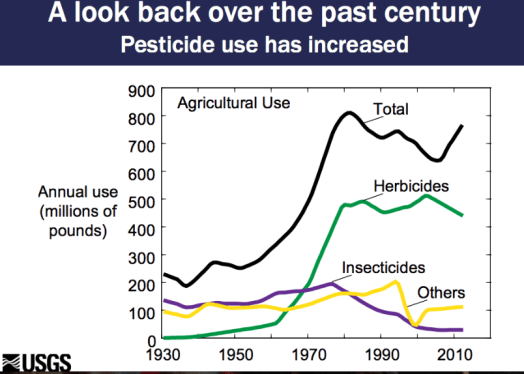
Many pesticides and herbicides that have been linked to numerous chronic illnesses are used on conventional crops. They are linked to developmental deficiencies in human children and fetuses, and diseases and declining populations of affected species of birds, insects, and other animals. “Pesticide drift” causes even further damages by wind transferring pesticide particles to places other than those sprayed; this causes air pollution and further damage upon local wildlife and ecosystems. According to a recent USGS, pesticides and herbicides were found to be present in all streams and 90% of wells. This chart from USGS demonstrates how often these present chemicals are exceeding maximum allowed thresholds for human and wildlife health:

This should be severely alarming to people, as water contamination limits the ability of an individual to make choices in accordance with circumventing the negative effects of these chemicals.
Hormones and antibiotics are used in conventional dairy and meat production. There is convincing evidence indicating that humans continuously ingesting traces of these substances could lead to stunted development in children and fetuses, and higher birth rates of twins and triplets. The same way pesticides and herbicides infiltrate our groundwater and general environment, hormones and antibiotics also pass through the human body and taint the biosolids. These hormones and antibiotics then are free to enter the ecosystems of aquatic and land life alike, which have been documented as having negative effects from this runoff including affected reproduction cycles and food supplies.
Antibiotics pose a grave danger when used in food production because their use over time can lead to antibiotic-resistant bacteria. This could lead to ineffective antibiotics in the medical field, costing mankind a heavily relied upon treatment. These potential deficiencies in the medical industry can lead to huge economic and human costs in the long run.
Like I said, we are only briefly overviewing the issues with nonorganic farming. For further investigation, I recommend you start with the Food and Agriculture Organization of the United Nations, SustainableTable.org, and the CDC. I have also listed additional research topics related to this article below.
So with all these problems associated with conventional farming, one might wonder- why is conventional farming even being pursued? The answer can be made as simply as a single word: profits. These shortcuts allow for lesser costs to producers, creating a more efficient short term supply side of the market. The demand for food is also ever-increasing what with the massive population growth our planet is straining under, and these solutions have been some of the easiest and cheapest to pursue. But without adequate regulations, and with the high pressure placed on the government by industry lobbyists, they will continue to happen.
While shopping for my own organic foods, I had noticed a few different ways of labelling to advertise the products in my local stores. I would see “Organic” or “100% Organic” or “USDA Certified Organic”. There are plenty of different definitions and standards pertaining to these labels, some of them more concerning than others.
The National Organic Program sets out the guidelines for the labelling of organic products. For a product to be labelled “100% organic”, all ingredients in the product must be organic- meaning no pesticides, herbicides, hormones, antibiotics, or biosolids have been used in production. However, this “100% organic” label neglects to include water and salt in its stipulations. Water can be tainted from pesticides, industrial waste, and other pollutants, so I find this stipulation questionable regarding the achievement of the truly organic product.
Products labelled “Organic” are allowed to have up to 5% of non-organic ingredients, once again not including any water or salt used in production. This site contains the list of ingredients that are allowed to be in “Organic” labelled foods at levels of up to 5% of the total ingredients. Also included in the site is a list of non-agricultural ingredients that are permitted at levels of up to 30% in foods labelled as “Made with organic ingredients”.
A “USDA Certified Organic” seal also exists and is on some organic products. Products with this seal come from a farm that is certified by the USDA as being up to its organic production standards. This requires an annual inspection of the farm, to ensure consumers that codes are being upheld. The requirements for certification by the USDA, and the economic incentives agriculturalists benefit from upon certification, can be found here.
For other labelling terms, including “no drugs or growth hormones used”, “free range”, and “sustainably harvested”, there are no actual regulations requiring truth or inspection in these claims. These terms thus can be used as misguiding labelling practices and should be observed with an appropriate level of doubt.
So now that we have reviewed the groundwork for organic food production, labelling, and consumption, we will return to the original point of this post. A few years ago, I started noticing that when I ate fruits, I would get an itchy mouth, or an itchy throat or ears. It seemed that I was starting to develop allergies, when growing up, I had had none. Confused about this development, I started buying a couple of produce items organically, having heard from a friend that some people experience pesticide allergies. The organic produce I tried out didn’t result in any allergy symptoms, prompting me to heavily consider the prominence of pesticides in grocery store foods.
But as I moved around throughout the last few years, I would buy my organic produce from different chain and independent grocery stores. Some, I noticed, would give me those allergic reactions, even though they were labelled organic. In a crossover week where I had bought organic apples from two different chain grocery stores, I noticed the substantial difference in time it took for the apples to begin browning when sliced open. This revelation disturbed me and prompted the beginning of an experiment.
One recent Saturday morning, I ran around the central New Jersey/eastern Pennsylvania area to collect organic bananas and organic Fuji apples from six different grocery stores. I had done some research into the validity of organic food claims in the previous week, and was shocked to find that no reliable test to validate organic food exists at this point in time.
Realizing how easy it would be for deception to potentially occur in the organic food industry, I decided I would attempt a basic visual test myself, to see if there were any suspicious results. Keeping all fruits at the same ambient room temperature at all times, I sliced them all open in tandem and watched and documented their decomposition. My hypothesis was that not all would decompose at the same rates, with some organic fruits staying “fresher” longer, assuming they were less organic than they were marketed as.
After 11 days of decomposition, the visual discrepancy in decomposition among the apples and bananas strengthened my suspicions and have prompted me to do a further investigation in the near future. The decomposition rates seemed to diverge from each other enough to warrant consumers’ attention. It appears, from this short pseudo-experiment, that these different labelling regulations and allowances may have a noticeable impact on our produce.
I will lay out the key points of this experiment’s trial run here for you to observe for yourself:


Organic bananas from five different grocery stores, all kept at the same conditions for eleven days, decompose at seemingly different rates.

The most drastic results were between these two organic bananas. Whereas one remained nearly the same size and color for all eleven days it was exposed to the air without its protective peel, the other shrank and shriveled as it dried up and turned brown. As you can see, the inner circle of the banana on the left kept its shape and form very adamantly. The center of the banana on the right has turned into one congealed dark brown area.


The results of the same experiment with organic Fuji apples yielded less dramatic visual results than the bananas, but the differences are still worth noting. As you can see in the following charts, in both the cases of the apples and bananas, neither fruit had consistent projected rates of decomposition.
Organic Bananas
| Store | Country of Origin | Initial Ripeness Rank | Decomposition Rank | Price | Company | Label |
| Whole Foods | Ecuador | 4 | 4 | 0.79/lb | ^ | Organic |
| Shop Rite | Peru | 2 | 5 | 0.79/lb | Chiquita | Organic |
| Trader Joe’s | Ecuador | 1 | 1 | 0.29/banana | Chiquita | Organic |
| Wegman’s | Colombia | 5 | 3 | 0.69/lb | Dole Organic | USDA Organic |
| ACME | Ecuador | 3 | 2 | 0.79/lb | Del Monte Fresh Produce | USDA Organic |
| ^ denotes unknown values | ||||||
Organic Apples
| Store | Country of Origin | Initial Ripeness Rank | Decomposition Rank | Price | Company | Label |
| Whole Foods | USA | 5 | 1 | 2.99/lb | Rainier | Organic |
| Trader Joe’s | USA | 4 | 2 | 2.99/2 lbs | ^ | ^ |
| Wegman’s | USA | 3 | 3 | 2.99/lb | Superfresh Growers | Certified Organic |
| Giant | USA | 1 | 5 | 2.99/lb | Nature’s Promise | Organic |
| ACME | USA | 2 | 3 | 2.99/lb | Superfresh Growers | Certified Organic |
| ^ denotes unknown values | ||||||
The visual discrepancies and the inconsistent rates of decay, shown by the initial and final rankings of the fruits, are apparent at least. However alarming this may look to an individual, however, it is important to keep in mind that this evidence here is not statistical and would need multiples of additional trials before it could be considered a complete study. I post these early findings not to make definite assertions, but because I believe they are suspicious enough that the consumer should be allowed to see for himself, allowing for his own research and decision making.
Organic agriculture is a lot more time consuming and costly than conventional agriculture. Though it may results in longer wait times, lower yields, and higher short term expenses for both producers and consumers, the alternative scenario is much worse in the long term. And if all of, or even a majority, of food production was made organic, higher rates of innovation would presumably bring production and product prices down over time.
More Sources
Environmental Impact of Antibiotics and Tetracycline on Environmental Systems
Trends in Nutrients and Pesticides in the Nation’s Rivers and Streams
Agricultural Land Application of Biosolids in Virginia: Risks and Concerns
 Garbage Girl: Environment & Politics